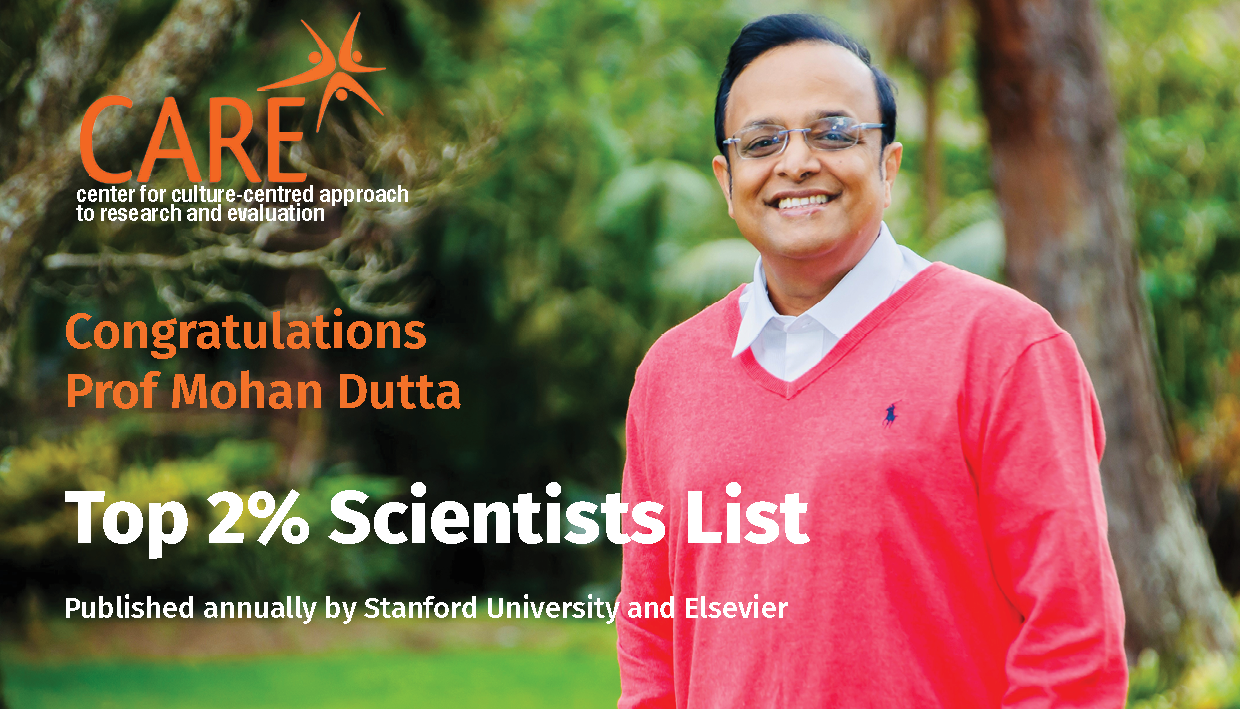
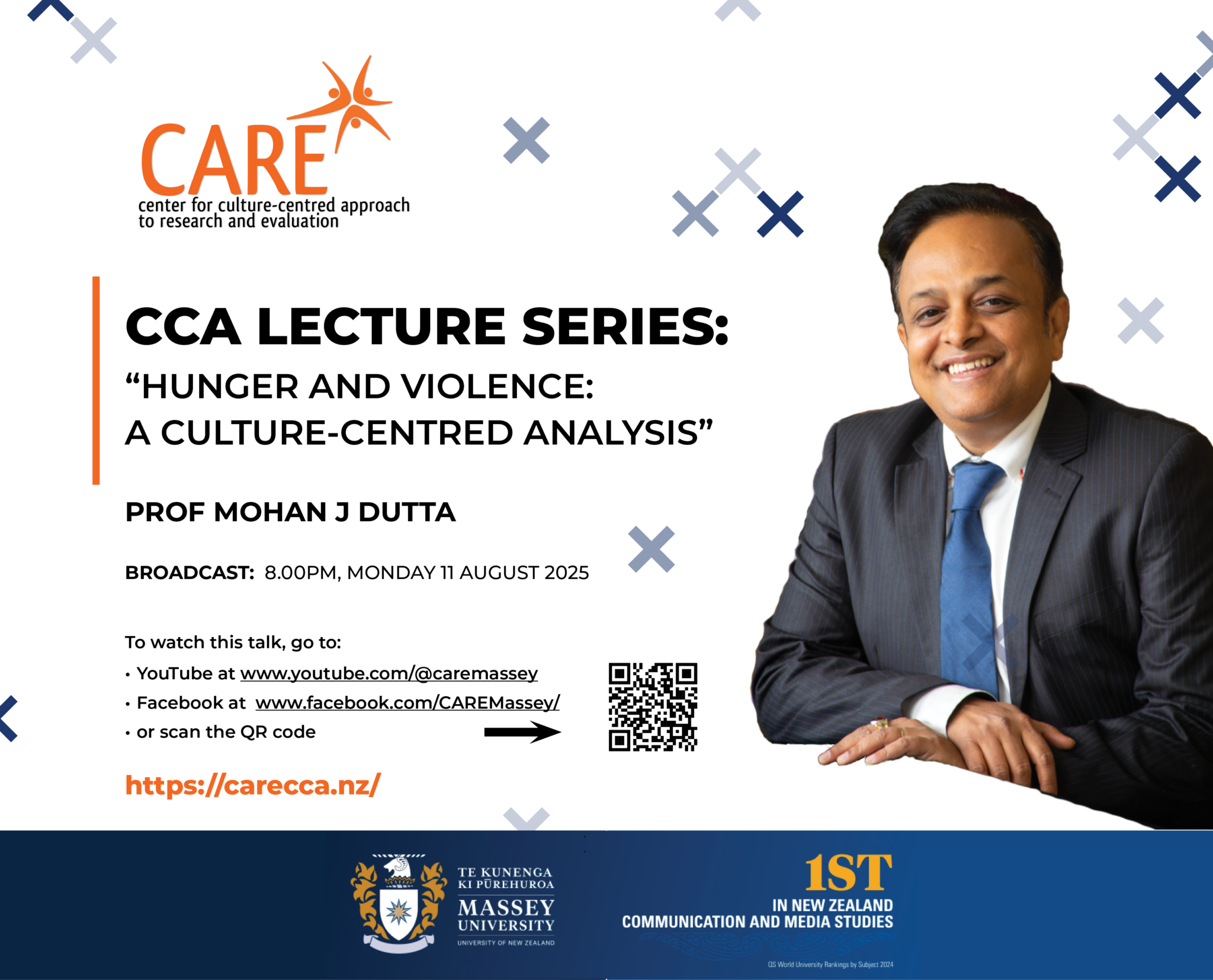
The Center for Culture-Centered Approach to Research and Evaluation (CARE) at Massey University is thrilled to announce that its Director, Dean’s Chair Professor of Communication, Professor Mohan J. Dutta, has once again earned a place among the world’s most influential scientists. For the fifth consecutive year, Professor Dutta has been named to the prestigious World’s Top 2% Scientists List, compiled by Stanford University and Elsevier.
This global ranking recognizes the most highly cited researchers across all fields, spotlighting their groundbreaking contributions to knowledge and innovation.
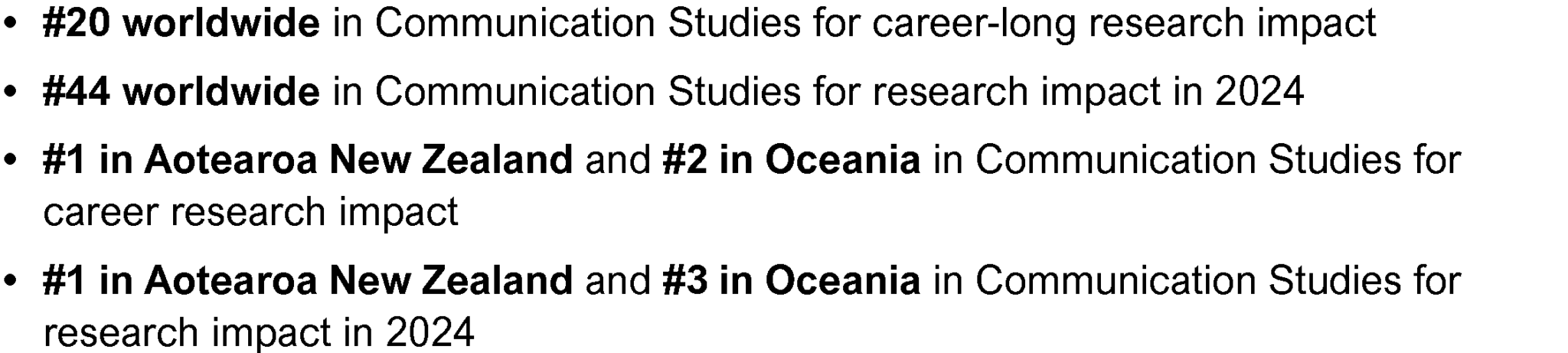
In 2025, Professor Dutta achieved extraordinary milestones:
These rankings underscore his global leadership in advancing transformative, community-driven scholarship that amplifies marginalized voices and creates real-world change.
“The honor of being recognized among the world’s top scientists for the fifth year in a row reflects the power of collective work,” said Professor Dutta. “This recognition belongs to the CARE team and our community partners, who everyday challenge inequities and co-create knowledge for justice. Together, we are reimagining what research can do in building more equitable futures.”
The World’s Top 2% Scientists List, based on citation impact, is one of the most respected measures of research influence globally. This year, 73 current and former Massey University researchers joined Professor Dutta on the list—cementing Massey’s place as a hub of research excellence and global innovation.
Professor Dutta’s visionary leadership continues to energize CARE’s mission: pioneering the culture-centered approach for social justice and change that positions communities at the heart of research, ensuring that solutions are shaped by the very people most affected by injustice.
Mohan Dutta, Dean’s Chair Professor of Communication at Massey University and Director of the Center for Culture-Centred Approach to Research and Evaluation (CARE) in the School of Humanities, Media, and Creative Communication, has been named the recipient of the inaugural Lawrence R. Frey Award for Distinguished Communication and Social Justice Activism Research. This new international award from the National Communication Association recognizes scholars who have made significant contributions to the study of communication activism and its role in social justice.
Dr. Dutta was selected for his extensive research and collaborative work with activist and minoritized communities worldwide. His discipline-defining culture-centered approach (CCA) is a framework that has been applied across the field of communication to challenge unjust narratives and deliver tangible benefits to vulnerable communities in various contexts.
The award committee highlighted Dr. Dutta’s dedication to addressing the harms of colonialism and his efforts to decolonize academic research. His work is noted for its impressive ability to bridge the gap between academic research and on-the-ground activism, directly leading to structural transformations for marginalized populations.
Notes the award citation, “Dr. Mohan Dutta’s expansive body of research and work with activist and minoritized populations across the globe has contributed significantly to the study of communication and social justice activism. His discipline-defining theoretical work on the culture-centered approach embodies the spirit of scholar-activist research and has been taken up across the field of applied communication to intervene in unjust discourses and deliver material benefits to vulnerable communities in numerous contexts. Dr. Dutta’s commitment to addressing the harms of colonialism, as well as his work decolonizing our own field, reveal his impressive ability to navigate the world of the researcher and the activist.”
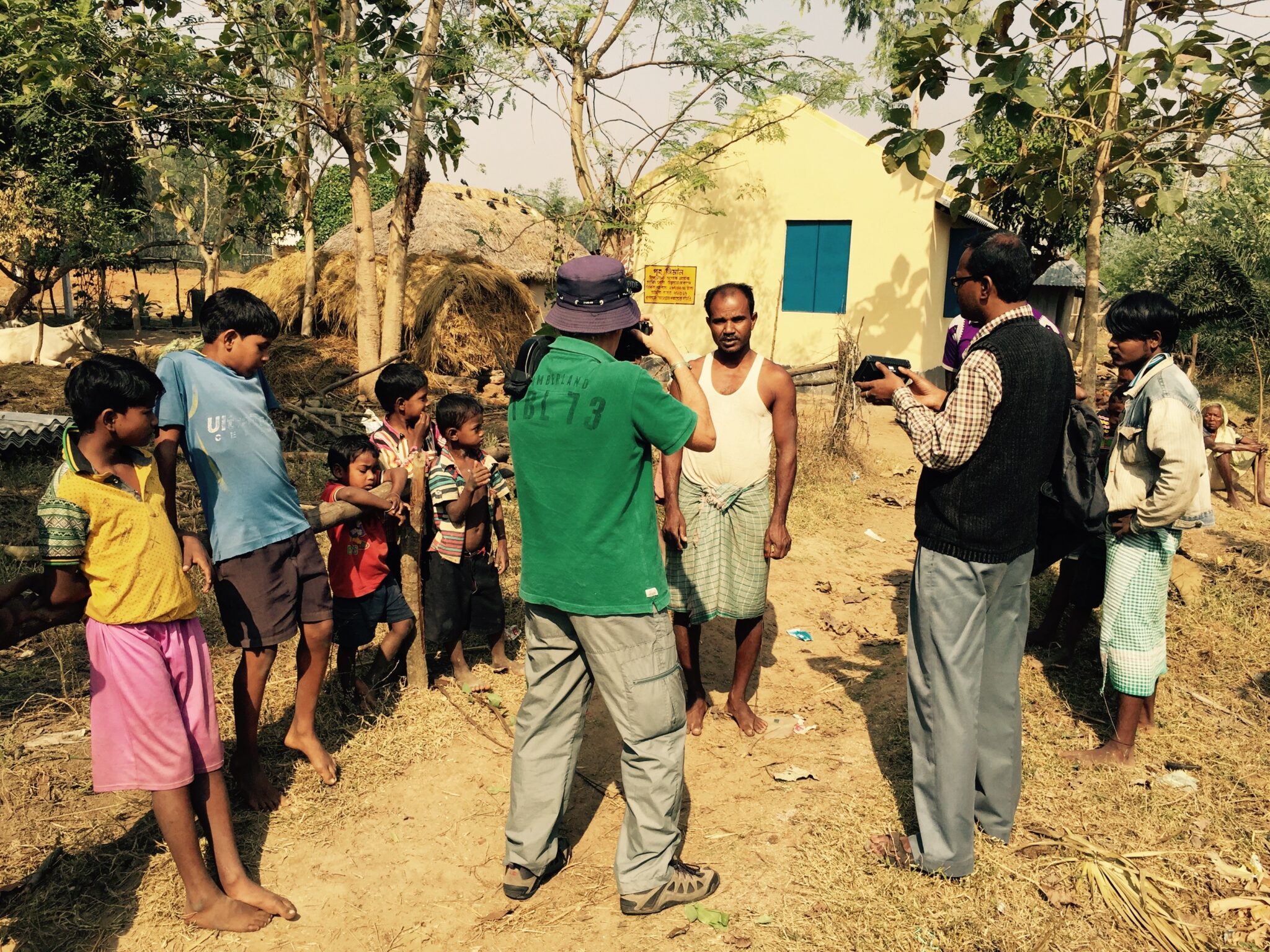
His research has been instrumental in creating activist and advocacy interventions that have had a direct policy impact on marginalized communities. The CCA has been applied to empower worker and migrant rights by co-designing campaigns that challenge precarious labor conditions and advocate for policy protections. He has also worked with questions exploring the rights of the poor by focusing on struggles for food sovereignty and health justice, leading to community-owned systems for clean water and food.
Furthermore, his collaborations with Indigenous communities across global contexts have centered their voices to secure rights to land, forests, and ecosystems. By linking community voices directly to national policy-making processes, Dr. Dutta’s work has been crucial in building “voice infrastructures” that address both communicative and material inequality, ultimately leading to impactful structural changes.
The Lawrence R. Frey Award honors the legacy of Dr. Lawrence R. Frey, a prominent scholar-activist known for his commitment to using communication research to promote social justice.

Dr. Fatima Junaid, Massey Business School, will bring her research on violent extremism and trauma in conversation with CARE Director Professor Mohan Dutta.
Thursday 17 April 2025 8pm NZST, Professor Mohan Dutta
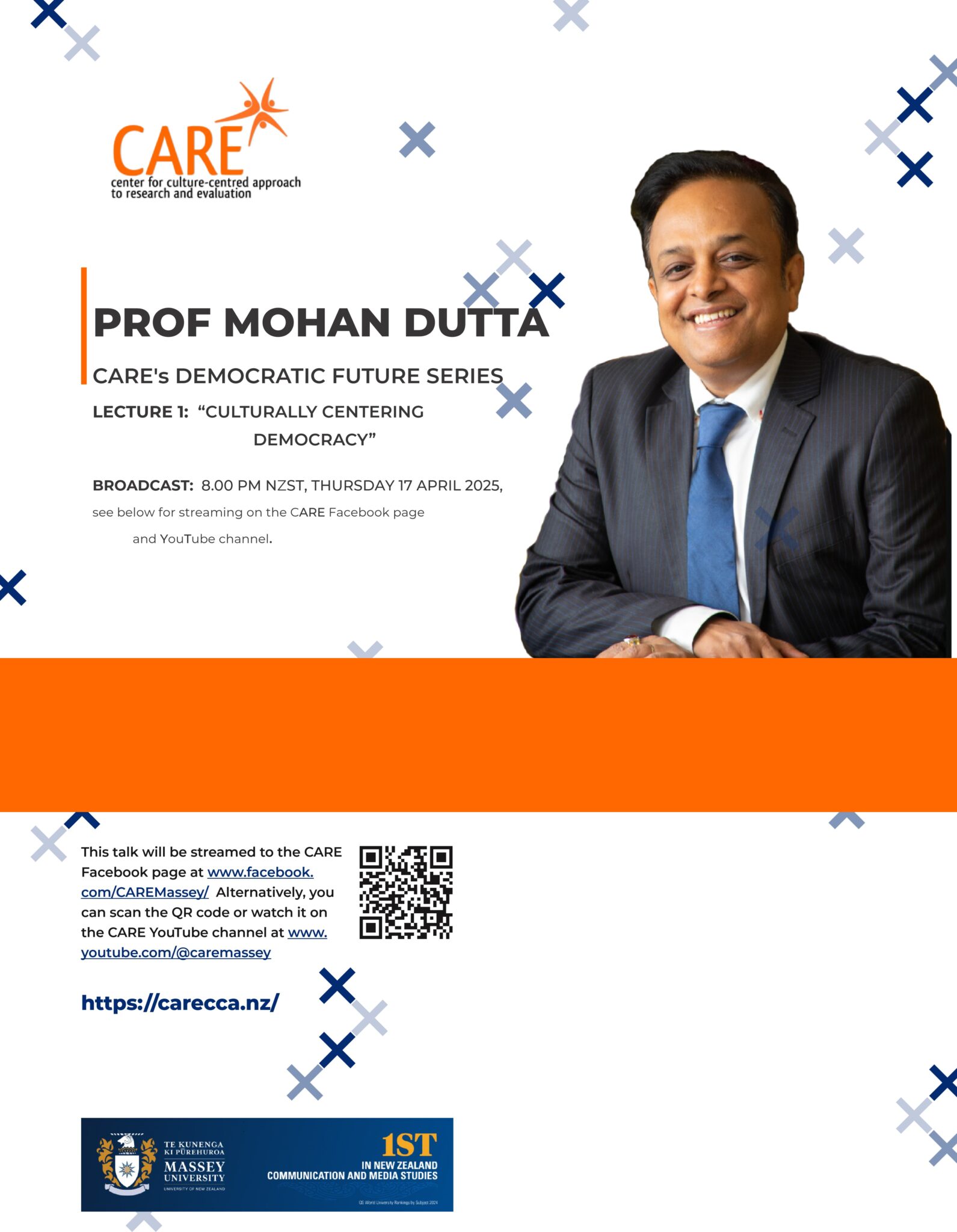
Coming soon CARE’s Democratic Future Series – Lecture 1 hosted by Professor Mohan Dutta “Culturally Centering Democracy” this Thursday 17 April 2025 8pm NZST. Live streamed on Facebook or alternatively you will be able to view it on CARE’s YouTube channel.
June 12-June 16, 2025, Massey University, Palmerston North, Aotearoa New Zealand
Oceania Hub: Aotearoa New Zealand
Hosted by:
Center for Culture-Centered Approach to Research and Evaluation (CARE)
Communication and Media Studies at Massey University
Organisers: Debalina Dutta, Sy Taffel, Sean Phelan, & Mohan Dutta
Call for Submissions EXTENDED; now Due on March 14, 2025, 11:59 pm NZST
The Oceania Hub of the International Communication Association (ICA) 2025 conference, hosted at Te Kunenga ki Pūrehuroa Massey University in Aotearoa New Zealand, explores questions surrounding disrupting Communication Research through the lens of Te Tiriti and Social Justice. Drawing on communication scholarship organised around the various registers of social justice, the Hub examines the intersections of communication theorizing and practice, mobilized toward disruptions and consolidation. The hub will be held in hybrid form, with both in-person and virtual sessions. Selected panels, papers, and interventions will be considered for waiver of conference registration fees.
We invite disciplinary and interdisciplinary submissions and multimedia communication interventions (video stories, film, performances, art forms, photographic images, sound productions) from the broader Asia-Pacific, focusing on the representation of the scholarship of communication practice from the Islands of the Pacific. The salience of Pacific participation is constituted around the global sustainability challenges of climate change, rising water levels, extreme inequality etc. We see the hub as offering an opening for disrupting what counts as communication scholarship through the engagement with practices of communication for social change.
The ICA Regional Hub at CARE will comprise a one-day hybrid workshop on “Connecting theory and practice as disruptions.” The workshop will bring in scholars from across the Asia-Pacific in both virtual and face-to-face sessions, focusing on key questions exploring the intersections of theory and practice in the context of addressing complex global challenges at a time when reactionary forces are on the rise. Aligned with the ICA 2025 conference theme of “Disrupting and Consolidating Communication Research,” the workshop will center the questions of disruptions from the context of the Pacific, anchoring the conversations in the struggles for justice and/or sustainability among others in communities across the Pacific. Sessions will connect with local organisers and activists in generating conversations on key questions on decolonizing knowledge. Centering the principles of Kaupapa Māori and indigenous methods across Asia and the Pacific, the workshop will explore the role of community as an organising space for building knowledge.
The Hub will operate in a hybrid model, with face-to-face participation complementing virtual participation. We welcome paper or panel submissions on the following topics and beyond:
The futures of struggles around diversity, equity, and inclusion (DEI)
Theorizing communication applications
Decolonizing communication scholarship
Sustainable communicative futures
Science communication futures
‘Disruptive innovation’ and social justice
AI and/as disruption
Disruptive alternatives to corporate platforms and infrastructures
Indigenous data sovereignty
Internationalization of the culture wars
Communication theory and mutant neoliberalism
The normalization of reactionary politics
Cultures of political resistance
Health communication and social determinants
Climate justice
Communication theory, transdisciplinarity and interdisciplinarity
Media cultures and ecologies
Imperialism, geopolitics and multipolarity
Critical development communication
We extend a special invitation to postgraduate students, activists and scholars from the Global South, Indigenous, LGBTQIA+ and those living with disabilities.
We invite submissions from the region addressing the theme “Disrupting and consolidating Communication Research.” The submissions can take the form of academic papers as well as multimedia forms beyond the text such as photos, audio, video stories, film, performance etc.
Please submit a title and an abstract no longer than 250 words. If you are submitting a multimedia intervention, please describe the interventions in the abstract. Please email your submission to Debalina Dutta at D.Dutta@massey.ac.nz by March 14, 2025, 11:59 pm NZST.