CARE Activist in Residence Public Talk – Sangeetha Thanapal Live Stream

CARE: Center for Culture-Centered Approach to Research and Evaluation Activist In Residence will be live !

Click on the Facebook Live Stream of the #CAREActivistInResidence: Public Talk by Sangeetha Thanapal at #MasseyUniversity below

Link: https://www.facebook.com/plugins/video.php…


More information on : https://www.facebook.com/events/266087930953323/  

A Conversation with Dr James Gomez

Professor Mohan Dutta sits down with CARE Activist-in-Residence Dr James Gomez of Asia Centre, a not-for-profit organisation that seeks to create human rights impact in the South-east Asia region.

Follow the link below for the in-depth interview of the academic, former politician, and Nobel Peace Prize nominee!

The Calls For War!

The attack, production of crisis, and elections


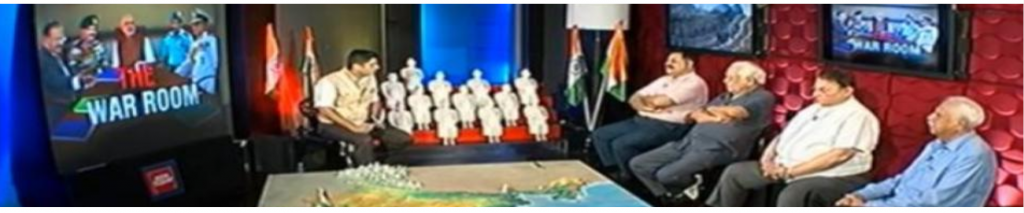
The attack on Central Reserve Police Force personnel in Kashmir’s Pulwama on February 14 has turned up the volume on the jingoistic media channels.

Jingoism sells. The images of violence sell in a concerted call for more violence.

The shouting matches on the split Television screens are perfectly orchestrated to call for war, with suited anchors frothing up at the sounds of war. As if to match up the tenor of the emotions at the site of the attack, the decked-up newsrooms buzz with the calls for attack. From the plush studio settings, mediatized images of the broken vehicles and streets littered with debris are organized into a propaganda campaign.

For the middle class digital sphere, the immediate calls to war from the comforts of the living room offer succour to middle class sensibilities of national security.

This is the mechanics of propaganda.

From Operation Iraqi Freedom to the surgical strike, images and sounds feed the war machinery.

In turn, the war machinery manufactures the images and sounds, pumping up adrenaline, drawing even more viewers in to the 24X7 cycles, driving the ratings up in an ever-accelerating pace.

Wars are powerful tools of propaganda. They feed on insecurity, the threat of the “other” materialized through images, talk, and sound, and the gory materiality of violence.

Manufacturing a war organizes entire collectives of citizens as nationalists, projecting on the national imaginary the threat to the nation, brought together with media images of terrorists that need to be targeted through attacks. This threat to the nation is circulated across media screens, capturing the emotions of citizens as war mongers, rallying behind the political elites and only to be satisfied with more gore.

Crises form the bedrock of authoritarian techniques of producing sites of control and managing them to keep power intact. When under threat of losing power, authoritarian regimes create a wide range of strategies to keep power intact. The spectacle of a terror event is the perfect crisis that calls for strong response, propping up the authoritarian strongman as the legitimate and necessary ruler.

Such a response is often produced amid suspended reason. Revenge must be sought, that’s all, and the authoritarian regime is well suited to extract revenge. That the middle classes that quickly demand such revenge never step into the violence of the war zones is part of the mechanics of war. That it is often the poor, enlisted into the police and military to escape poverty, who must place their bodies amid violence, is part of the mechanics of war.

Moreover, the production of war and the circulation of geostrategic threats work well as communicative strategies for generating public support for authoritarian power. Wars often supply the perfect recipe for authoritarian regimes that hold on to power through appeals to emotion. Catalysing the citizen around the nation and national interests works well to distract from questions of economy, inequality, unemployment, and difficulties of everyday life.

The recent attack in Kashmir seemed to have offered the perfect backdrop for the mobilizing of patriotism. Noted Modi, issuing a warning to Pakistan that India will not be divided: “If they (Pakistan) think that the kinds of things they are doing, the conspiracies that they are concocting — that they will be successful in creating instability in India, then they should abandon that dream. They will never be able to do it.”

As television stations capitalize on the ratings-generating stories of the attack, the nation is once again organized around the enemy, with the call to protect national security. Heuristics of the enemy unify national sentiments, captured in smart techniques of producing the other.

Amid crisis, critical questions are suspended. The audience is configured into a homogeneous mass of collective hysteria.

Wars are also the backdrop for attacking the opposition in an election cycle. Building up to the elections, digitally circulating images quickly pick up stories that equate the opposition with the “other” of the nation. The ruling political party becomes the nation, and the nation the party.

Any critique of the jingoism is dangerously painted as anti-national, with large consequences. Any opposition to the regime is painted as the enemy of the nation. Facebook posts, YouTube videos, Tweets, and WhatsApp messages quickly circulate these

Consider for instance the photo of Rahul Gandhi, photoshopped with the Pulwama suicide bomber. The post,“भारतीय फौज पर हमला करने बाला नीकला राहुल गांधी का खास। क्या इस हमले के पीछे कांग्रेस का हाथ तो नहीं (The man who attacked the Indian army was close to Rahul Gandhi. Is the Congress behind the attack? -translated)”, made on the Facebook group Once Again MODIRAJ 2019, includes photoshopped images of Rahul Gandhi to suggest that the involvement of the Congress in the attack.

Consider similarly cropped videos of Priyanka Gandhi allegedly laughing after the terror attacks.

These images and stories work strategically to paint an increasingly strong opposition as the enemy. The war is a powerful political machinery, one that will quickly organize national politics around its agenda.

Amid these heightened calls to war, consider the critical questions that call for further reflection and deliberation. What are the places of dialogue amid this violence? What role does violence play in mitigating violence? Situate the police-military deaths in war alongside the deaths of civilians and protesting people in Kashmir. Most importantly, consider the question of sovereignty of the Kashmiri people that forms the backdrop of this violence.

by Mohan Dutta

Source: https://www.thecitizen.in/ind ex.php/en/NewsDetail/index/4/16300/The-Calls-For-War
White Paper Launch with Dr Sue Bradford and Professor Mohan J Dutta

The transformative capacity of collaboration between academics and activist offers a pivotal anchor for local-national-global resistance. In the white paper on academic-activist partnerships, Dr. Sue Bradford and Professor Mohan Dutta draw from their journeys in academia and activist organising to examine the intersections, synergies, challenges to, and lessons for academic activist partnerships. Questioning the meaning of collaboration and the nature of collaborative spaces in social change, the authors offer a conceptual framework for collaboration that joins in solidarity with the struggles of the oppressed.

You can read the White Paper by clicking the link below:
 

Follow the link below for our final Activist-in-Residence video with Dr Bradford:

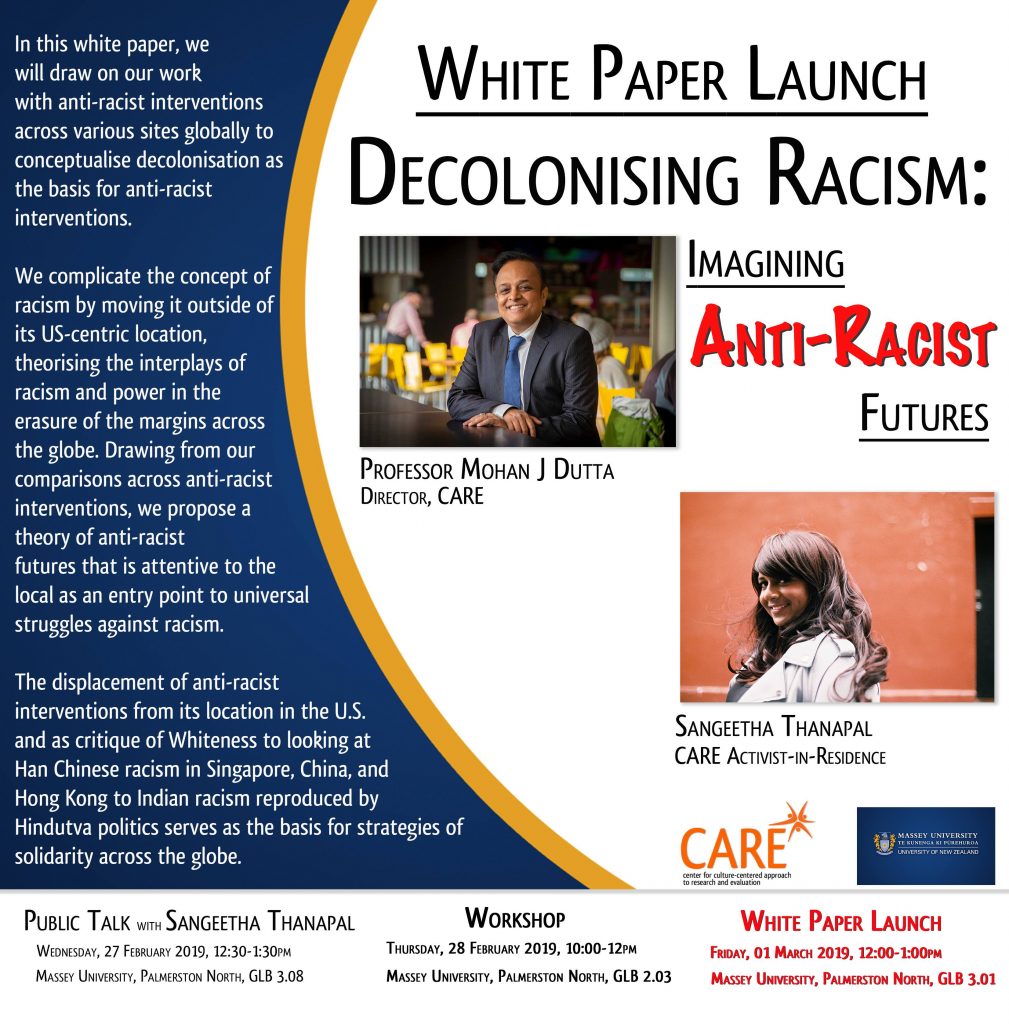
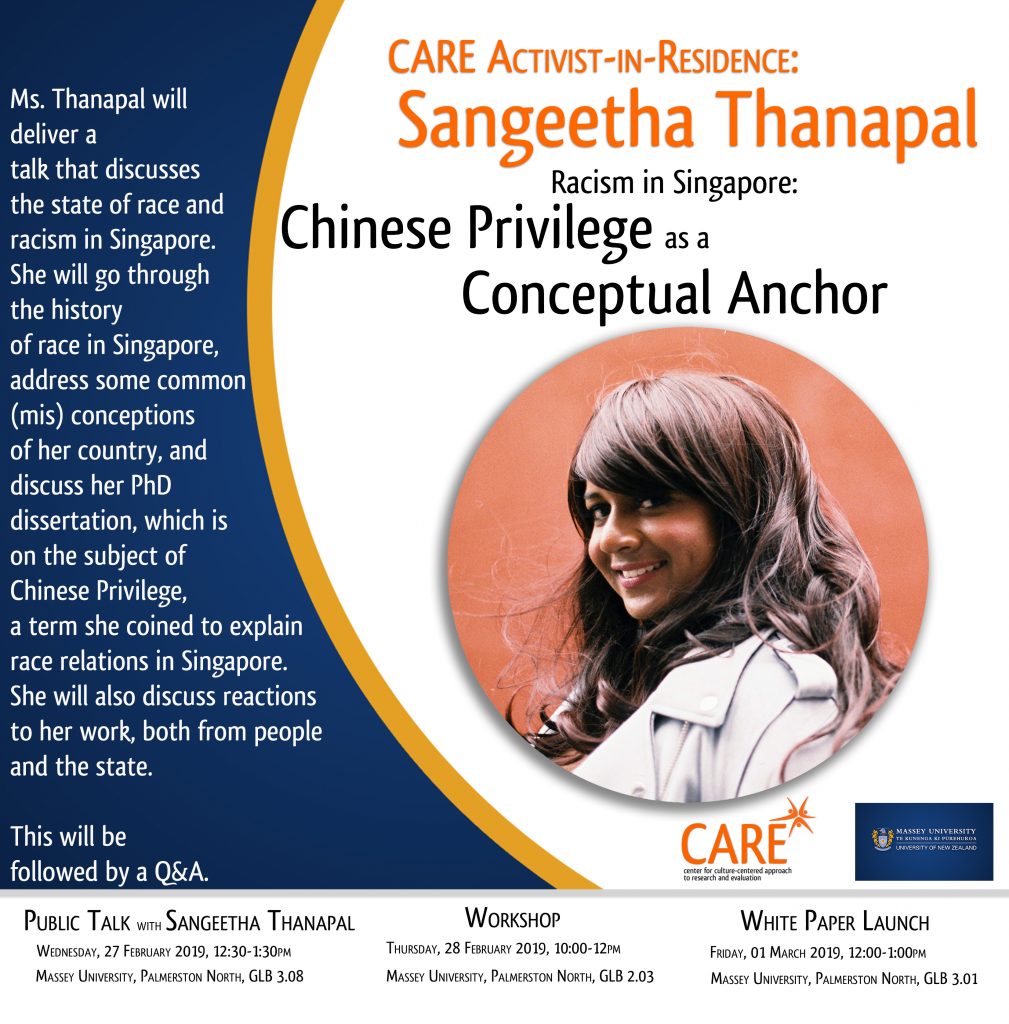
CARE- Activist-In-Residence- Sangeetha Thanapal- 27th February-1st March at Manawatu campus

Kia ora koutou,

As we begin this new semester we are pleased to announce that we have 2019’s First Activist-In-Residence at CARE

from 27th February-1st March at Manawatu campus.

Our theme for this semester for our Activist-in-Residence series is “Anti-racist Interventions!”

Our first activist-in-residence is the Singapore activist Sangeetha Thanapal, whose work on Chinese privilege has

intervened into the racist structures of Chinese imperialism. Here is a link to her website: http://kaliandkalki.com/


She was recently interrogated and issued warning by Singapore Police for her anti-racist work under the colonial anti-sedition law:

https://www.straitstimes.com/singapore/courts-crime/activist-sangeetha-thanapal-issued-stern-warning-for-facebook-post-that

Prof. Mohan Dutta  will be working with Sangeetha to share some of CARE’s ongoing work with racist structures that marginalize

Indians in South-east Asia and strategies for race-based activism. She will be presenting a Public Talk, Workshop and Whitepaper during her residency at CARE.

More event specific details to follow shortly.

Click on the url link for media related articles on Sangeetha Thanapal

A Conversation with Dr Sue Bradford

In the latest video of our Activist-in-Residence video series, Professor Mohan Dutta, Director of CARE, sits down for a one-on-one interview with Dr Sue Bradford and talks about her life in politics and activism.

Watch this compelling interview by following the link below!

Academic-activist partnerships in struggles of the oppressed

ISSUE2. (NOVEMBER 2018) 

Academic-activist partnerships in struggles of the oppressed

Dr. Sue Bradford & Prof. Mohan Dutta

In this advocacy brief, we examine the transformative capacity of collaboration between academics and activists offering a pivotal anchor for local-national-global resistance. In the white paper on academic-activist partnerships,
Dr. Sue Bradford and Professor Mohan Dutta draw from their journeys in academia and activist organizing to
examine the intersections, synergies, challenges to, and lessons for academic activist partnerships. Questioning
the meaning of collaboration and the nature of collaborative spaces in social change, the authors offer a
conceptual framework for collaboration that joins in solidarity with the struggles of the oppressed.

Bradford, D. and Dutta, P. (2018). Academic-activist partnerships in struggles of the oppressed. CARE WHITE PAPER SERIES, (Issue 2).

Article: White_Paper_Sue_Bradford_Mohan_Dutta-November 2018

Director’s Blog

OXFORD RESEARCH ENCYCLOPEDIA ENTRY: POWER AND CONTROL

by Prof. Mohan Dutta

It was summer. A summer when the violence escalated.

In those months, when the repression accelerated from polite threats to sit down meetings to direct threats to the accusations, I was writing this encyclopedia entry on Power and Control for the Oxford Research Encyclopedia of Communication.

Witnessing power work through the cells of my body, feeling my body respond to the repression from bouts of throwing up to losing consciousness, disrupted my understanding of power as communicative, anchoring the discursive sites of power in material articulations.

I felt the brute effect of power even as I was writing about it.

My readings and re-readings of Marx, Adorno, Gramsci were intimately intertwined with my experiences with power, resisting it, and negotiations of it in an ever-contingent space of (im)possibilities.

In this Review, I explore the interplays of the discursive and the material in the production of power and control. Power is both a force that perpetuates oppression as well as a vital source of emancipatory resistance. The review works through the question of power from interpersonal and organizational levels to political, economic, and societal realms. It attends to the contemporary context of power in the digital, circulated through structures and networks of data, in the surveillance and manipulation of behaviors, and the continuous search for extractive sites for digital capital.

Here is the link to the article:

http://oxfordre.com/communication/view/10.1093/acrefore/9780190228613.001.0001/acrefore-9780190228613-e-636

APA citation:

Dutta, M. (2018). Power and control in communication studies. In Oxford Research Encyclopedia of Communication. Oxford University Press. doi: http://dx.doi.org/10.1093/acrefore/9780190228613.013.636