CARE Op-Ed: The communicative strategies of Hindutva

by Prof. Mohan Dutta, Massey University
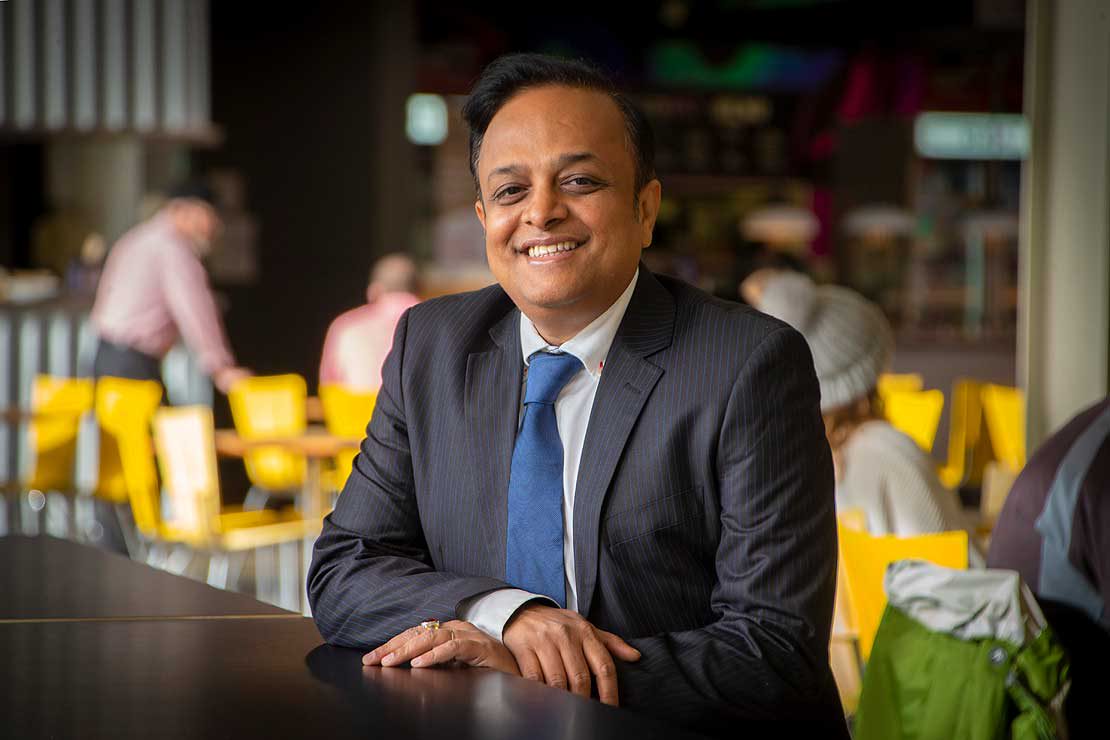
Professor Mohan Dutta, director of the Center for Culture-Centered Approach to Research and Evaluation (CARE) at Massey University.

Hindutva, a political ideology that seeks to construct India in the structure of a Hindu nation (Hindu Rashtra), draws its conceptual tenets from the organising framework of fascism. As a modern project, Hindutva is rooted in the desire to create a Hindu nation that is organised on the principles of the European nation-state through cultural hegemony that homogenises the population, simultaneously erasing the rights of religious minorities.

The fascist root of Hindutva is evident in the writings of one of the key architects of the concept, MS Golwalkar, who writes: “German race pride has now become the topic of the day. To keep up the purity of the race and its culture, Germany shocked the world by her purging the country of the Semitic races – the Jews … a good lesson for us in Hindustan to learn and profit by.”

Note here the deep interplays of the ideology of Hindutva and white supremacy. The purity of race and culture that forms the hate structure of white supremacy is mobilised in the political formation of Hindutva. Hindutva embodies the colonial imposition of a politics of purity through the purge of the ‘other’ organised by the state.

One of the key architects of Hindutva, Vinayak Damodar Savarkar, wrote the book Hindutva in 1923, outlining the concepts of a common nation (rashtra), a common race (jati) and a common culture or civilisation (sanskriti). Note the parallels here with the ideology of the German Nazi party, anchored in ein volk(one people), ein reich (one nation), ein Fuhrer (one leader).

At the heart of this ideology is the production of the ‘other’ that is outside of the nation. Similar to the construction of Jews as the outside of ein volk in Nazi ideology, Muslims and Christians are constructed as the outside of the Hindu rashtra in the ideological construction of Hindutva.

The effects of this ideology are evident in the hate and violence that have been directed at Muslims. The ongoing political project of disenfranchising Muslims through the Citizenship Amendment Act (CAA) is a reminder of the Nuremberg Laws passed in Nazi Germany to strip German Jews of their citizenship.

The communicative infrastructure of Hindutva is deployed through the articulation of a monolithic ‘Hinduness’ as the basis for organising the political project. To belong, one has to declare their ‘Hinduness’ and allegiance to the Hindu Rashtra, as defined by the political project of Hindutva.

To dissent from this monolithic vision of Hindutva is to be anti-Hindu. Within the organising structures of India, to dissent against the ideology of Hindutva is to be anti-Indian. The political project of Hindutva threatens the pluralism, polymorphism, and democratic ethos of Hinduism.

The celebrated Indian film-maker Anand Patwardhan, observed at the Dismantling Global Hindutva conference, “If Hindutva is Hinduism, then the Ku Klux Klan is Christianity.”

The recent attacks on me, the Center for Culture-Centered Approach to Research and Evaluation (CARE), Massey University, and on academics globally writing on and debating about the pernicious effects of Hindutva, are reflective of the hegemonic communicative infrastructure of Hindutva. At the heart of this hegemonic infrastructure is the silencing of dissent while imposing a monolithic ideology. In this instance, Hindutva proclaims to speak for all Hindus as it carries out this fundamental attack on academic freedom.

From trolls reproducing digital hate, to hateful propaganda published in diaspora digital portals, to letter writing campaigns targeting the university, to petitions attacking the university for steadfastly supporting academic freedom, forces of Hindutva draw on a wide range of strategies. Hindutva deploys bullying and rhetorical fallacies to silence dissent because it lacks the tools of argumentation to appeal to reason.

Referring to these forces of Hindutva at work to silence academic freedom in the form of the organised attacks on the Dismantling Global Hindutva conference, Professor Gyan Prakash, Dayton-Stockton Professor of History at Princeton University, observes: “The extraordinary thing about the conference was the massive disinformation campaign by those seeking to prevent the academic scrutiny of Hindutva. The campaign launched against this conference was concerted, comprehensive, and entirely without scruples. As has been covered in the Guardian and Al Jazeera, many participants received threats, including death threats. We know that, as a co-sponsoring institution, you also faced overwhelming pressure to pull out from this conference. The threats include nearly every threat to academic freedom listed on the AAUP’s (American Association of University Professors) website.”

Of particular concern in western democracies are the threads of foreign influence and interference into academic freedom and the fabric of pluralism.

In western democracies, Hindutva seeks to silence criticism by communicatively inverting the violence perpetuated by the political ideology of Hindutva, while simultaneously playing to the ethos of superficial western multiculturalism. It projects a narrative of fragility, constructing references to Hinduphobia, in seeking to assert its cultural hegemony in the diaspora, while simultaneously silencing dissent and articulations of social justice. Hindutva actively erases the voices of adivasis (indigenous people), oppressed caste communities, women experiencing gender violence, gender diverse communities, and minority communities in seeking to establish the hegemony of its monolithic values.

In our work at CARE that seeks to co-create spaces for the voices of the ‘margins of the margins’ to be heard, we will continue to pursue our justice-based scholarship in spite of the organised forces of hate seeking to silence these voices by policing the term Hindutva. We are empowered in this work by the steadfast support of the leadership of Massey University in safeguarding our academic freedom, and in the protections offered by the Education Act 1989.

Related articles

Professor Mohan J. Dutta recognised as Distinguished Scholar


Professor Mohan Dutta named ICA Fellow

Article Source: Massey University News


© 2021, Center for Culture-Centered Approach for Research & Evaluation
(CARE). All rights reserved.

Professor Mohan J. Dutta is recognized as a Distinguished Scholar by National Communication Association (NCA)

CARE congratulates Professor Mohan J. Dutta, Dean’s Chair Professor and Director, CARE for his recognition as a 2021 National Communication Association (NCA) Distinguished Scholar

Presented annually, the Distinguished Scholar Award is NCA’s highest accolade. It honours a lifetime of scholarly achievement in the study of human communication. Recipients are selected by their peers to showcase the best of the communication discipline.

NCA logo image source: https://www.natcom.org/

Over a span of two decades, Professor Dutta has developed the culture-centered approach through his ethnographic justice-driven communication scholarship carried out in solidarity with communities at the “margins of the margins” across the globe. Spanning seventeen countries across four continents, the impact of this scholarship is felt in communities experiencing structural deprivation, through the creation of infrastructures for voice, participation, and community democracy. Fostering community participation in everyday grassroots democracies for social change, the program of research led by Professor Dutta has created community development solutions; designed material infrastructures such as community-owned food systems, hospitals, educational infrastructures, and systems of clean drinking water; led community-owned advocacy and activist campaigns, and guided public policy.

The Center for Culture-Centered Approach to Research and Evaluation (CARE) built by Dutta has led and carried out over fifty community-led social change projects across the globe, working with Indigenous communities, low-wage migrant workers, refugees, sex workers, precarious workers, domestic workers, rural communities, communities experiencing poverty, disabled communities, rainbow communities, minority communities, ageing communities, and farmers. The activist-in-residence programme at the Center, white papers, and community dialogues created anchors for structural transformation.

Theoretically, the framework of the culture-centered approach has been recognised as one of the most significant theories of communication, reflected in the Charles H. Woolbert Research Award, given to a “journal article or book chapter that has stood the test of time and has become a stimulus for new conceptualizations of communication phenomena.” His work with landless oppressed caste women farmers in Telangana organised into a cooperative has been recognised with the NCA Golden Anniversary Monograph Award. The CCA has formed the basis for over hundred research projects in marginalised communities across the globe.

Upon the recognition with the Distinguished Scholar award, noted Professor Dutta,

“The significant challenges of health and wellbeing, poverty, inequality, climate change, food security, access to clean drinking water, and peace and social cohesion outlined in the Sustainable Development Goals call for creative solutions built through community leadership and participation. I am humbled with this recognition as it speaks to the transformative power of communication, and particularly of voice infrastructures at the margins in leading the processes of structural transformation.”

In carrying out this work, Professor Dutta has educated, mentored and nurtured over three generations of students, community leaders, and activists, many of whom represent marginalised identities. His mentorship of scholars from the Global South has been recognised with the International Communication Association Aubrey Fisher Mentorship Award. Earlier this year, he was recognised with the NCA Health Communication Division  Award for “Outstanding contributions to promoting Equity and Inclusion.”

Professor Dutta is also recognised with the 2015 ICA Applied Public Policy Communication Researcher Award and is an ICA Fellow.

The NCA citation reads,

“Dr. Dutta’s research examines the role of advocacy and activism in challenging marginalizing structures, the relationship between poverty and health, and the ways in which participatory culture-centered processes serve as axes of global social change, among other topics. Dr. Dutta’s research program includes 10 books, over 200 articles and book chapters, and has been cited over 12,000 times. Dr. Dutta provides extensive intellectual leadership; they have directed 46 doctoral dissertations, facilitated numerous workshops, and served as editor of Journal of Applied Communication Research.”

Professor Dutta will be receiving the award at the NCA 107th Annual Convention in November.

#CAREMassey #MasseyUni #CARECCA #National Communication Association #NCA21

© 2021, Center for Culture-Centered Approach for Research & Evaluation (CARE). All rights reserved.
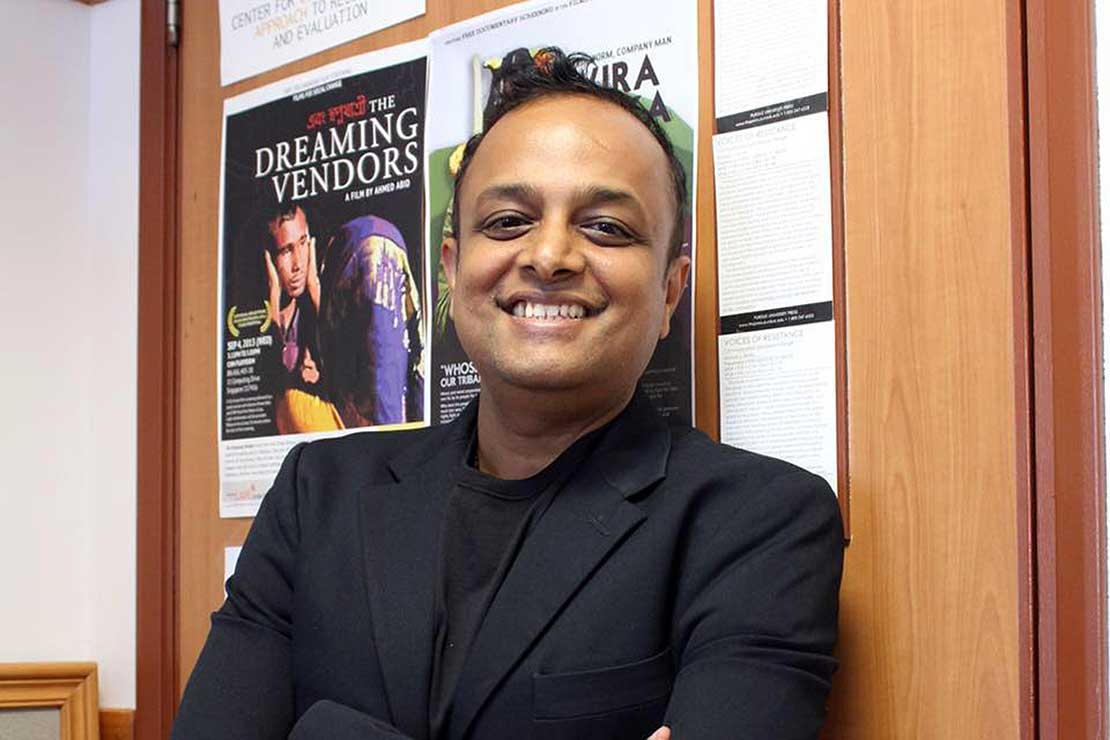
Professor Mohan Dutta is recognised with Outstanding Contributions to Promoting Equity and Inclusion Award by the National Communication Association

Professor Mohan Dutta, Dean’s Chair in Communication at School of Communication, Journalism & Marketing, Massey University is recognised with Outstanding Contributions to Promoting Equity and Inclusion Award by the National Communication Association.

CARE: Center for Culture-Centered Approach to Research and Evaluation congratulates Professor Mohan Dutta, as the inaugural recipient of the Outstanding Contributions to Promoting Equity and Inclusion Award of the Health Communication Division, National Communication Association. This award recognises Professor Dutta’s significant and sustainable contributions to addressing inequalities in health outcomes through communication interventions that seek to change unequal structures. Over two decades, he has created and led community-led culture-centered solutions to health and wellbeing among the most marginalised, creating spaces for communities to own decision-making processes. These culture-centered solutions have addressed classed, raced, gendered inequalities that adversely impact human health and wellbeing and created sustained changes in the overarching structural determinants. Outstanding Contributions to Promoting Equity and Inclusion Award by the National Communication Association. In promoting equity and inclusion across communities at the margins spread over eight countries, he has mentored multiple generations of academics, activists, and community researchers. This has contributed to the transformations in the disciplinary structure of health communication, building the basis for a movement toward equity.

Referring to Mohan Dutta’s influence on promoting equity and inclusion, noted Dr. Satveer Kaur-Gill, “Dr. Dutta has not just significantly contributed to toward theoretic health communication literature but has built an impressive register for socially impactful scholarship through community-led change in some of the most disenfranchised communities in different parts of the globe. His public scholarship is an exemplar for how to build health equity amidst marginalization and in challenging the very structures that impede health. This includes writing countless opinion pieces regarding important and challenging health and social issues of our time, leading social change campaigns, participating in protests, writing and signing petitions, and developing strategies alongside communities for changing structures.”

#CAREMassey #PromotingEquityAndInclusionAward #NationalCommunicationAssociation #HealthCommunicationDivision #HealthCommunication #CARECCA #MasseyCJM #MasseyUni

#CAREMassey,#PromotingEquityAndInclusionAward, #NationalCommunicationAssociation, #HealthCommunicationDivision,#HealthCommunication #CARECCA,#MasseyCJM,#MasseyUni,

Follows us on: www.facebook.com/CAREMassey/posts/5158580567491640

CARE News: CARE Researcher wins Early Career Researcher award by National Communication Association Health Communication Division

It gives us all @ CARE so much joy to celebrate this achievement, says Center for Culture-Centered Approach for Research & Evaluation (CARE) Director, Prof. Mohan Dutta.

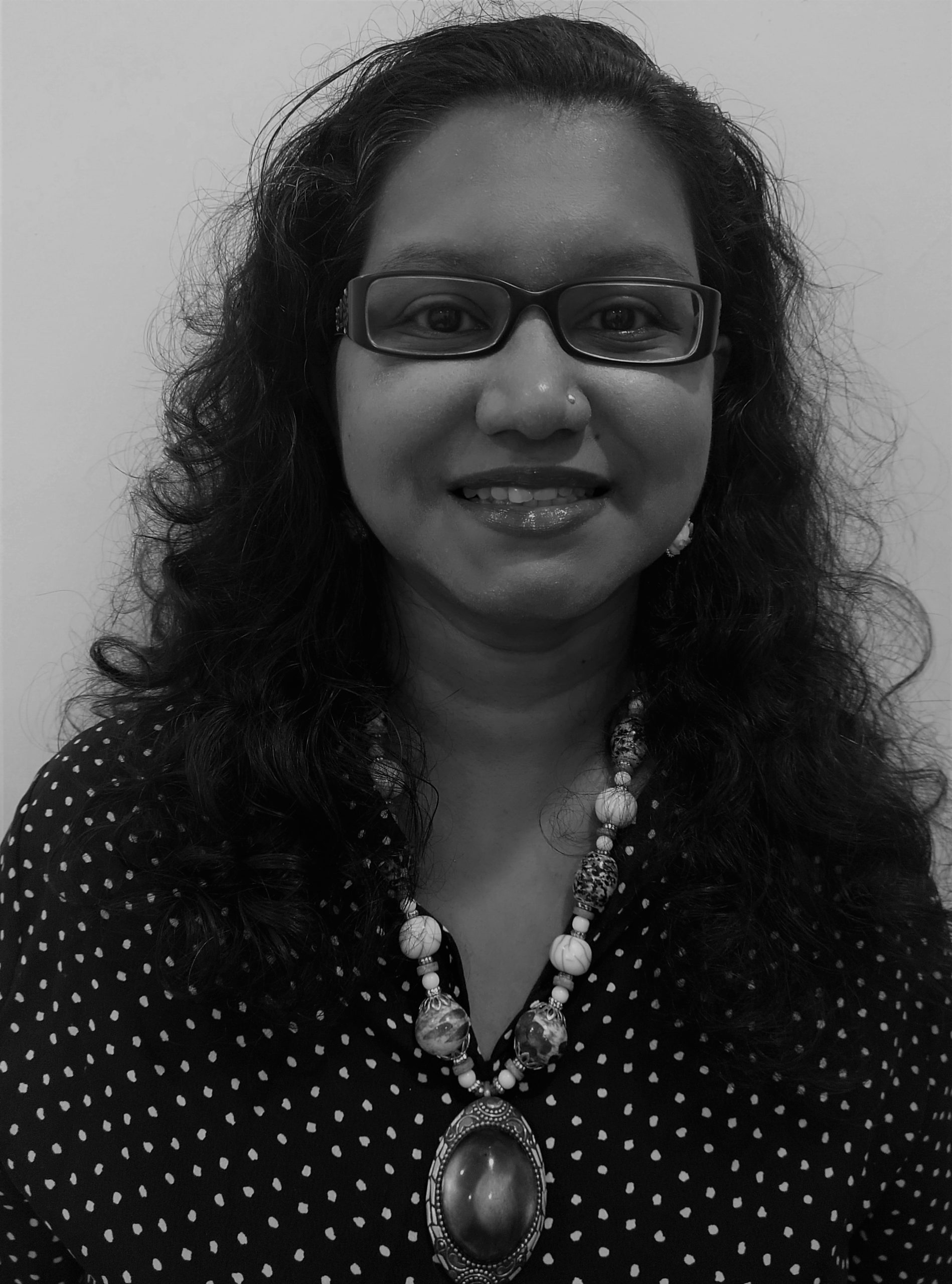
Congratulations to Dr. Satveer Kaur-Gill, on behalf of everyone at CARE, for your recognition with the National Communication Association Health Communication Division Early Career Researcher award.

Dr. Satveer Kaur-Gill

Prof. Mohan Dutta said, “This award speaks to your brilliance, courage, and social impact. You are the kind of scholar that reflects the mission of our discipline, to work through communicative practices to build better health and wellbeing for all. Your bold, structurally transformative, insurgent scholarship bears testimony to the power of the discipline in transforming structures, elucidating the power of communication in creating infrastructures for better health and wellbeing among the most marginalised by placing your body on the line. Your program of research rooted in community-engaged service, research anchored in community voice and teaching practice committed to nurturing an ethics of care rooted in social justice reflect the futures of health communication, depicting the powerful contributions communication scholarship can make to the contemporary global challenges of health inequities. It is rarely do we see a scholar who embodies such a strong combination of theoretical depth, methodological rigor, and commitment to transformative health communication practice. Most importantly, it is your courage and your integrity that offer the pathways for what it means to practice health communication for structural transformation.”

Follow us on https://www.facebook.com/CAREMassey/posts/5154914557858241

#EarlyCareerResearcherAward #NationalCommunicationAssociation #HealthCommunicationDivision #CARECCA #CAREMassey #MasseyUni

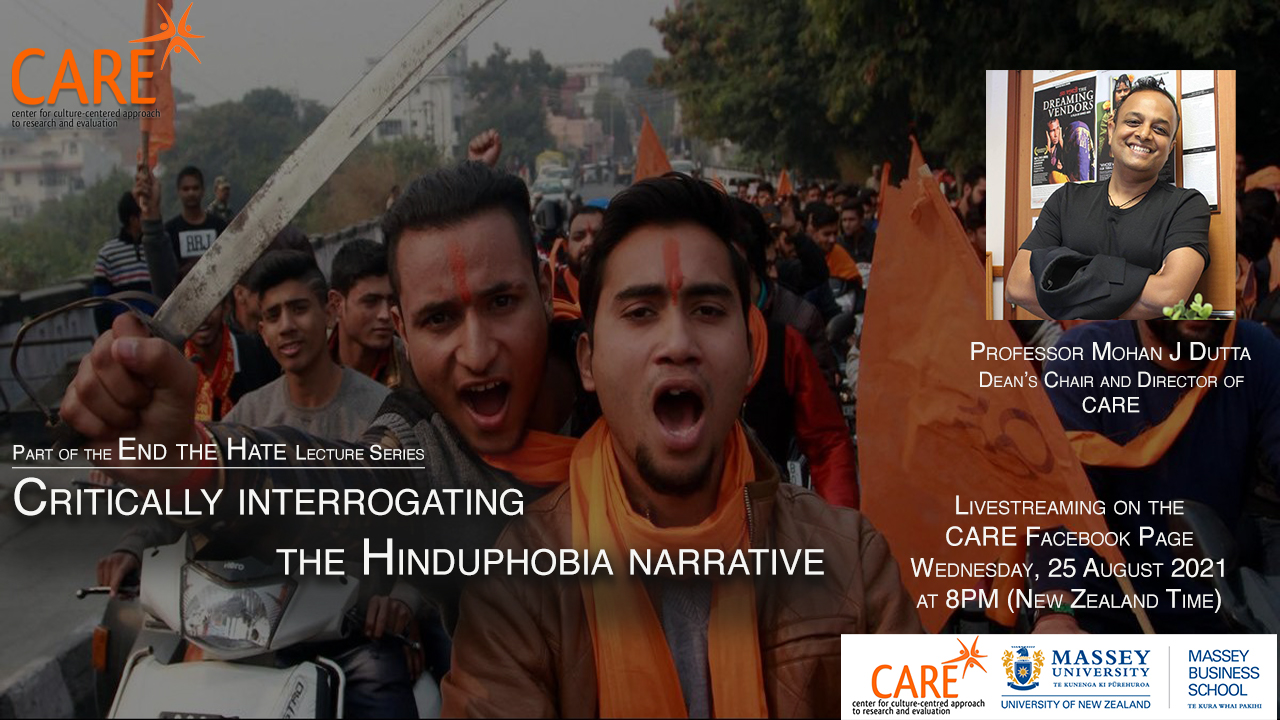
CARE #EndTheHate Lecture Series: Critically interrogating the Hinduphobia narrative with Prof. Mohan Dutta

Date: Wednesday 25th August 2021 Time: 8 pm NZST
Venue- Facebook broadcast on : https://www.facebook.com/CAREMassey

Lecture Title: Lecture Series: Critically interrogating the Hinduphobia narrative with Prof. Mohan Dutta

Lecture Abstract:
In this lecture, Professor Mohan Dutta will draw on his work on anti-racist interventions to critically interrogate the language of Hinduphobia and the ways in which it is deployed in liberal democracies to silence critiques of the infrastructures of hate being deployed in India and globally.We look forward to seeing our colleagues and collaborators, at this #CARETalk as part of our “End the hate” series.

Follow us for more updates on: https://www.facebook.com/CAREMassey

#EndTheHate #AntiRacistInterventions #Hinduphobia #India #CARELectureSeries #CAREMassey #CARECCA #MasseyUniversity #MasseyCJM

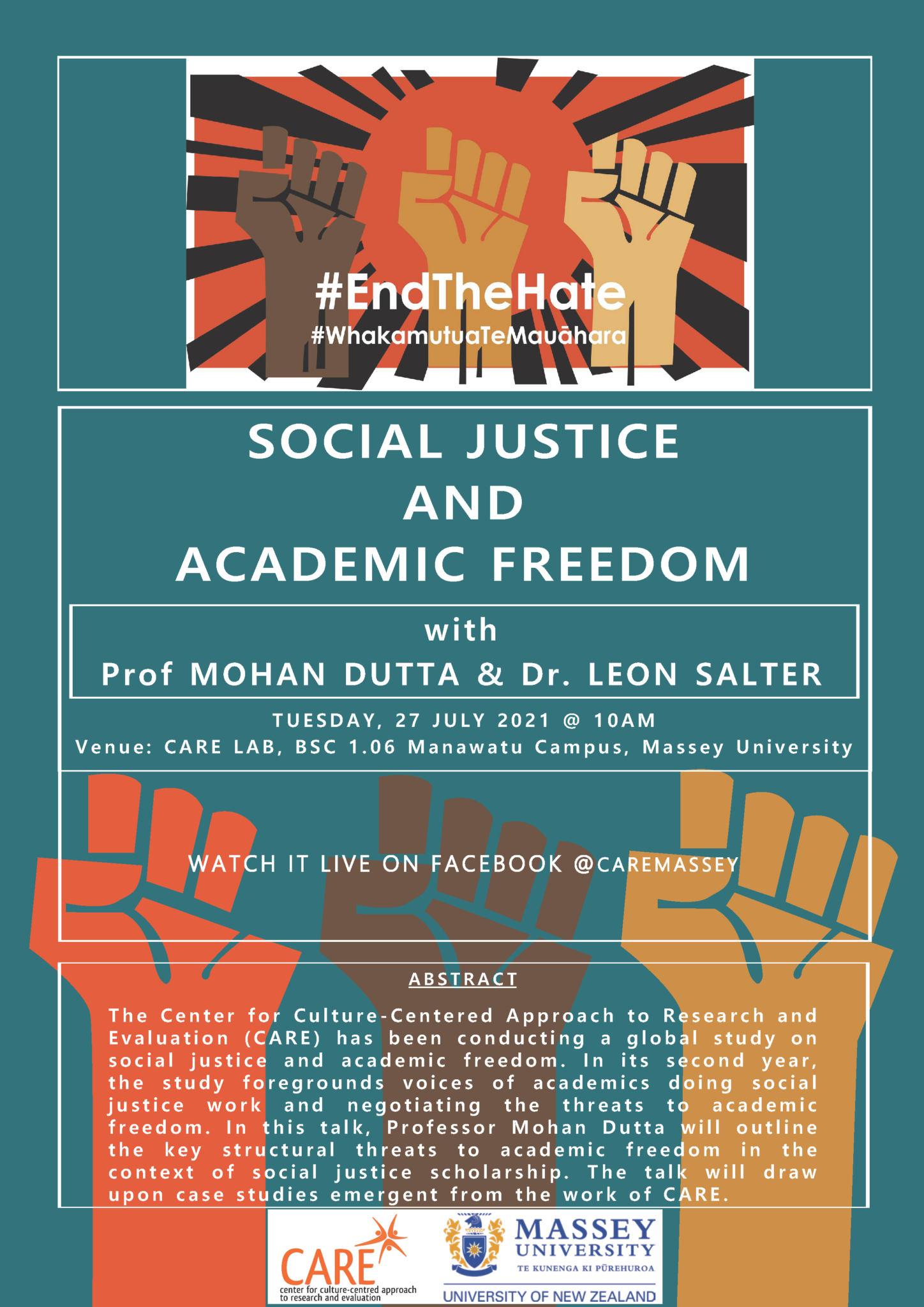
CARE Talk on ‘SOCIAL JUSTICE AND ACADEMIC FREEDOM’ with Prof Mohan Dutta & Dr. Leon Salter, Massey University

CARE Talk on ‘SOCIAL JUSTICE AND ACADEMIC FREEDOM’ with Prof Mohan Dutta & Dr. Leon Salter, Massey University Tuesday 27th July 2021 @ 10 AM Venue: CARE Lab BSC 1.06, Manawatu campus, Massey University.

Tuesday 27th July 2021 @ 10 AM

Venue: CARE Lab BSC 1.06, Manawatu campus, Massey University.

Facebook Livestream: CARE Talk: Social Justice and Academic Freedom with Prof Mohan Dutta & Dr. Leon Salter

Talk Abstract:

Social Justice and Academic Freedom

The Center for Culture-Centered Approach to Research and Evaluation (CARE) has been conducting a global study on social justice and academic freedom. In its second year, the study foregrounds voices of academics doing social justice work and negotiating the threats to academic freedom. In this talk, Professor Mohan Dutta will outline the key structural threats to academic freedom in the context of social justice scholarship. The talk will draw upon case studies emergent from the work of CARE.

#CARECCA #CARETalk #SocialJustice #AcademicFreedom #MasseyUni #MasseyCJM

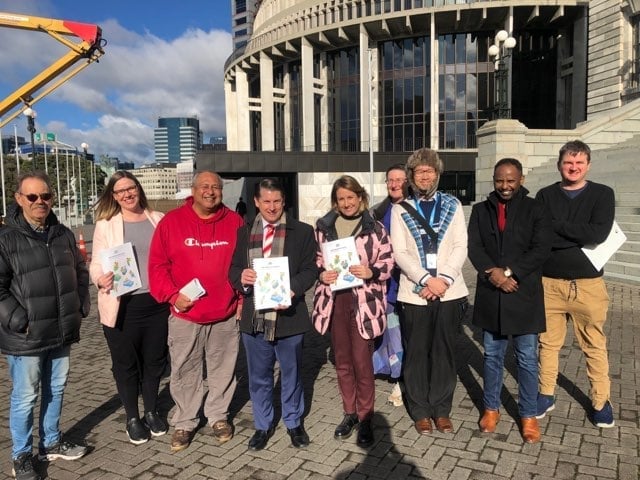
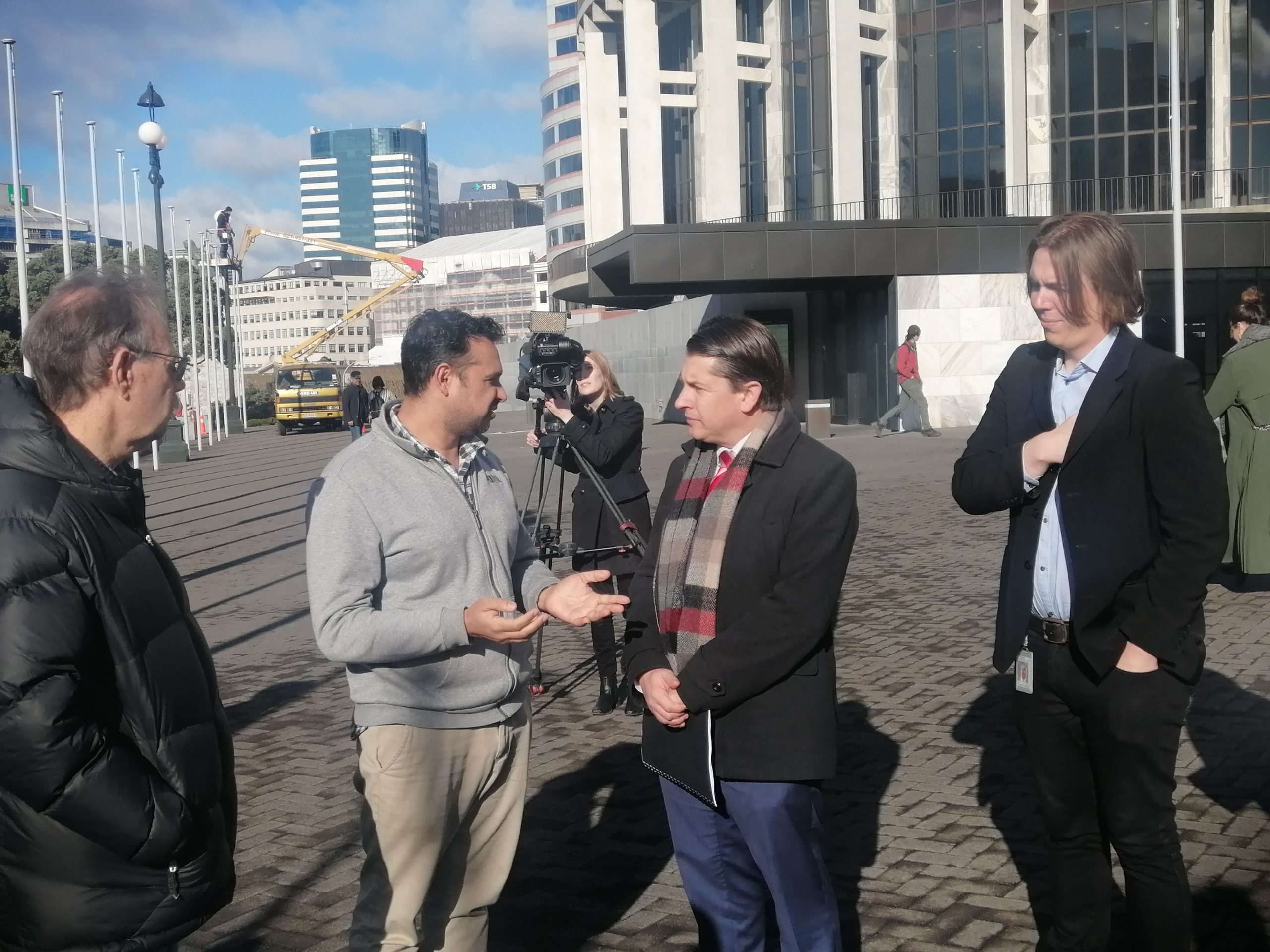
CARE Researcher Dr. Leon Salter attended the FIRST Union report launch on gig work in Aotearoa at New Zealand Parliament

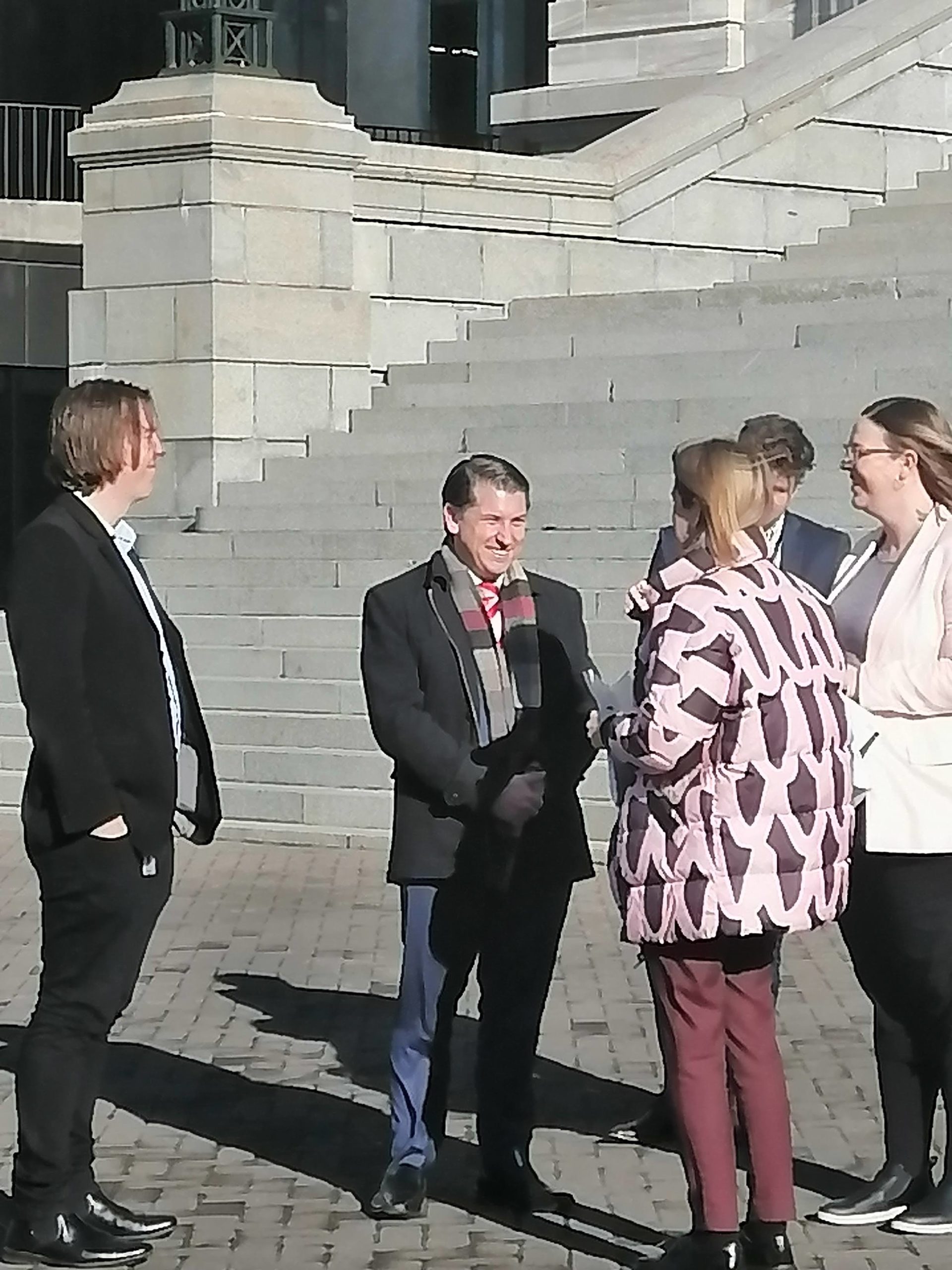
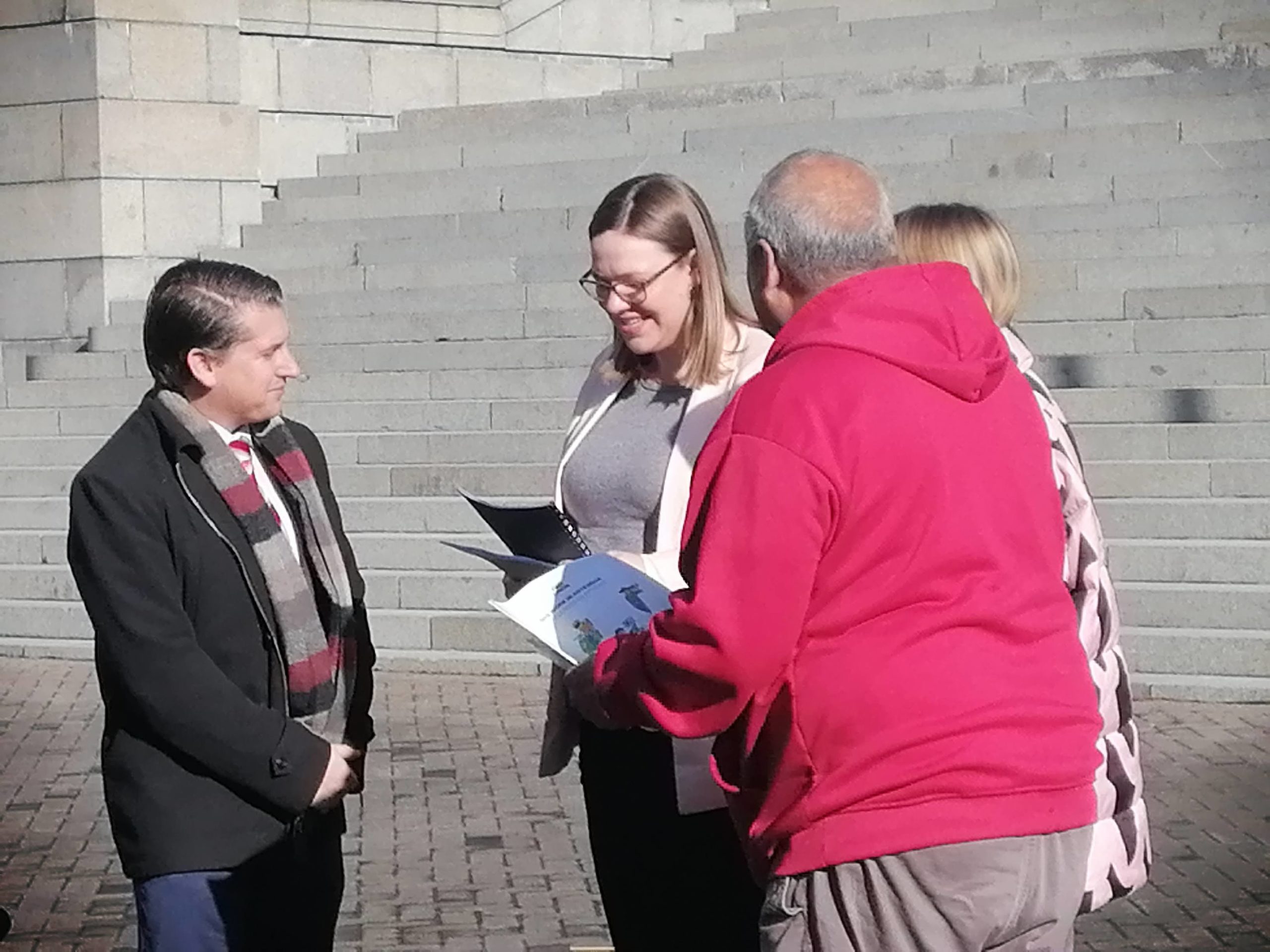
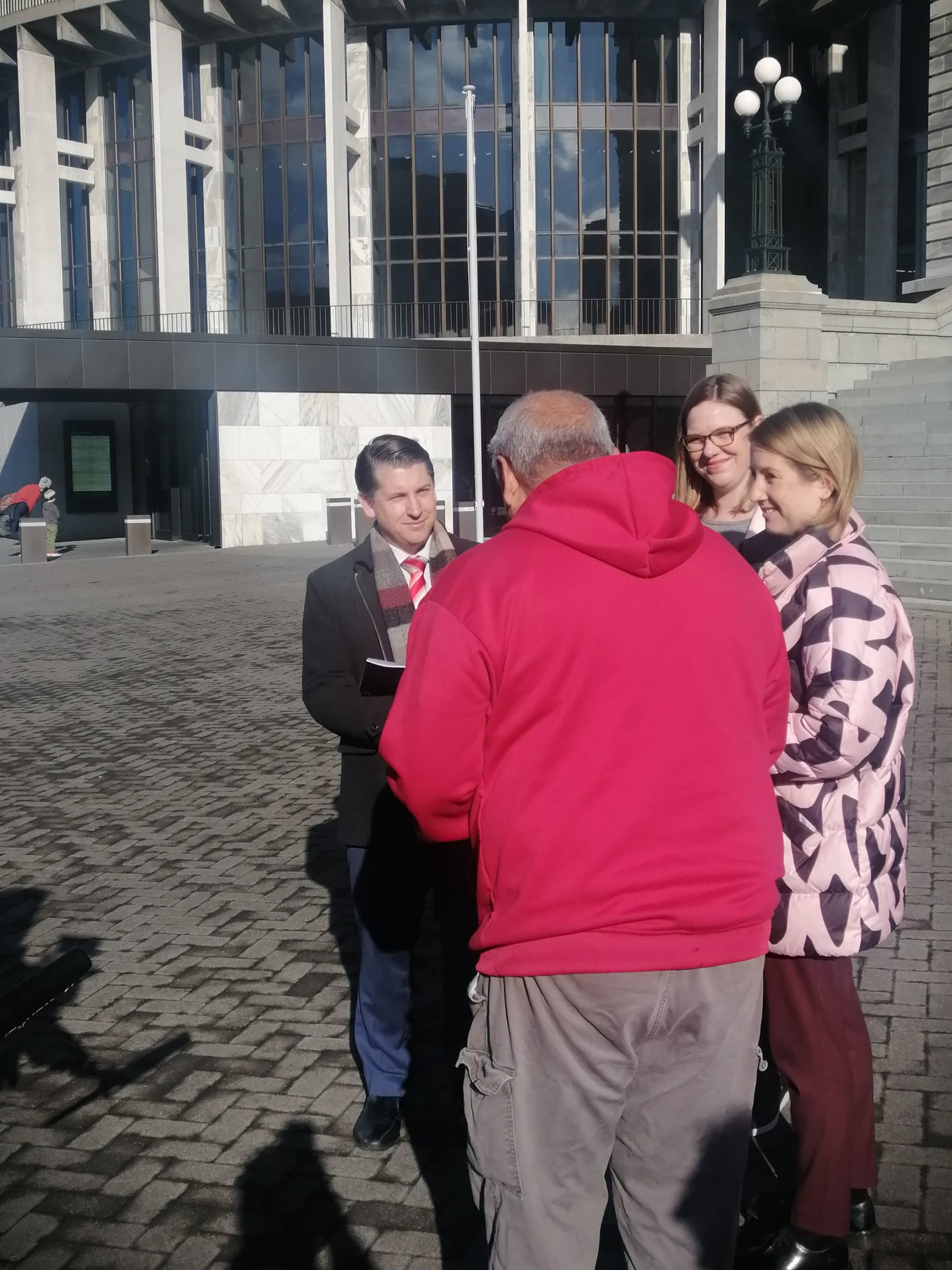
Dr. Leon Salter, Massey University‘s academic staff and CARE: Center for Culture-Centered Approach to Research and Evaluation researcher on #CAREMassey‘s project-“Experiences with Covid-19 Among Gig Workers” attended the FIRST Union report launch at #NZParliament earlier today.

Minister Michael Wood being handed FIRST Union’s excellent gig worker report this morning at Parliament.

Read the press release with a link to the report here https://www.scoop.co.nz/stories/BU2107/S00211/uber-drivers-to-file-in-employment-court-as-new-gig-economy-report-launched.htm

Image Courtesy: Dr. Leon Salter & FIRST Union

#GigWorkers #NewZealand #Aotearoa #FIRSTUnion

CARE is excited to welcome back Dr. Asha Rathina Pandi as a Research Fellow

We are excited to welcome back Dr. Asha Rathina Pandi as a Research Fellow at the Center. At CARE, she will lead the Labour and Race in Asia Project, with her research focusing on the health of Plantation and Migrant workers in Malaysia.

Previously, she held teaching and research positions at the Department of Communications and New Media, Center for Culture-centered Approach to Research and Evaluation (CARE), and Asia Research Institute at the National University of Singapore. Asha received her PhD (2011) and M.A. in Sociology (2005) from the University of Hawaii at Manoa (UHM), USA. She also holds a M.Sc. (2000) and Bachelor’s degrees in Urban Planning (1996) from University Technology of Malaysia, and a Graduate Certificate in Global Health and Population Studies from UHM (2012).An academic-activist, Asha has 18 years of experience in higher education. Her teaching and research interests are in social change and justice, health communication, community engagement, mixed methods and marginalized populations. She has published in journals of International Development Planning, Journalism, Development Studies, Frontiers in Communication, among others. At the Department of Communications and New Media at the National University of Singapore, she led and taught the Communication for Social Change course that created a register for pedagogy of structural transformation for students.

We look forward to the transformative openings that Dr. Pandi will build in her work at CARE!

CARE News: Prof. Mohan Dutta serves on the World Health Organization (WHO) expert group on Culture & Health.

CARE: Center for Culture-Centered Approach to Research and Evaluation is proud to share news that for the last five years, Prof. Mohan Dutta has served on the World Health Organization (WHO) expert group on #Culture & #Health.

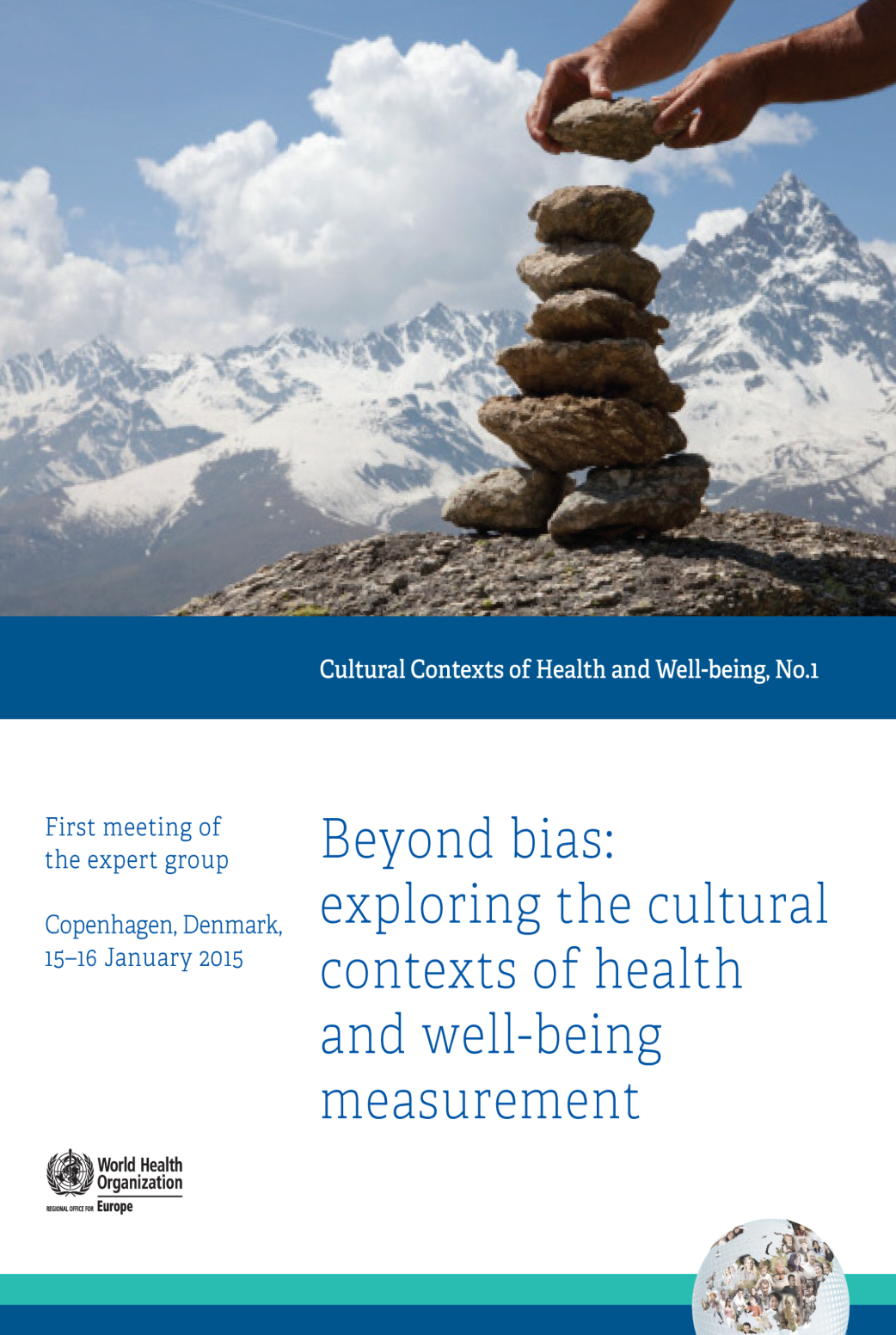
The outcome of this collective work/report is titled, “Beyond bias: exploring the cultural contexts of health and well-being measurement”.

Abstract: This first expert group meeting on the cultural contexts of health and well-being was convened by the WHO Regional Office for Europe on 15–16 January 2015. As part of the adoption of Health 2020, the European policy for health and well-being, WHO Member States agreed to a measurement framework, which would measure and report on objective and subjective well-being. However, practical challenges remain, particularly with respect to the influence of cultural factors on well-being and well-being measurement. The aim of this meeting was to provide advice on how to consider the impact of culture on health and well-being, and how to communicate findings from well-being data across such a culturally diverse region as Europe. This report outlines the detailed recommendations made by the expert group in relation to each of these objectives.

Read the report here: https://www.euro.who.int/…/Cultural-contexts-health.pdf

#CAREMassey#CAREMasseyNZ#CARECCA#MasseyUni#worldhealthorganisation#WHO#CulturalContextsOfHealth